Gardening Services Finsbury Park — Recycling and Sustainability
At Gardening Services Finsbury Park we place sustainability at the heart of every lawn, border and pruning job. Our approach to an eco-friendly waste disposal area focuses on preventing landfill, reusing where possible and working with borough schemes for correct separation. We set a clear recycling percentage target across our operations: a companywide goal of 75% recycling and reuse for all collected garden and household-like waste, with an aspirational benchmark of diverting 90% of green waste from landfill through composting and redistribution.
 We work closely with local boroughs on waste separation best practice: the common Haringey and Islington approach to separate food waste, garden/green waste, glass, paper and mixed recycling influences how we sort debris on site. Our teams are trained to reduce contamination, bag materials appropriately for council collection when requested, and to segregate woody material, soil, compostable matter and recyclables at the point of collection to maintain high recycling rates.
Practical recycling activity and local transfer stations
We make practical use of nearby facilities and minimise haulage miles by routing loads to local transfer stations and resource recovery centres. Where appropriate we use borough transfer stations in Haringey and Islington as primary drop-off points for separated streams, and arrange bulk movements to larger consolidation sites to process green waste into compost. Our logistics planning aims to consolidate journeys, which protects air quality in the Finsbury Park area and supports an effective sustainable rubbish gardening area on every site we serve.
 Our on-site process includes:
- Segregation of green waste, soil and recyclables into labelled containers;
- Composting or delivery of suitable green waste to local municipal composting facilities;
- Reuse and donation of healthy plants, pots and soil where possible.
Partnerships with charities and community organisations
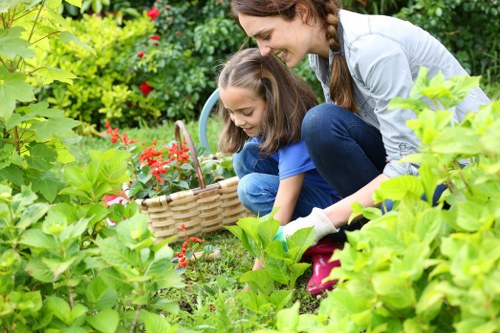 A core part of our sustainability policy is partnership. We collaborate with local charities, community gardens and social enterprises to channel usable materials back into the community. Usable soil, potted plants, raised bed timbers and tools that pass safety checks are offered to food-growing charities, community allotments and youth gardening projects. These partnerships extend the life of garden resources and help create resilient, greener public spaces across Finsbury Park and neighbouring wards.
 We also work with redistribution networks to ensure that any reusable items are offered to organisations supporting local households. When plants or materials are not suitable for reuse, they are processed through composting or sent to accredited recycling streams to meet our ambitious recycling targets. This dual approach reduces waste while supporting social value in the local area.
To further reduce carbon we deploy a fleet of low-carbon vehicles: electric vans for short urban runs and the latest low-emission Euro 6 vehicles where charging infrastructure limits apply. Route optimisation software and consolidated weekly scheduled visits reduce fuel use and emissions, and we are progressively increasing our number of electric vans and cargo bikes for small jobs within Finsbury Park. Our transport policy is a practical part of creating a genuinely low-impact gardening services in Finsbury Park offering.
Operational transparency is important: we record waste streams on every project and publish aggregated recycling performance for the calendar year. Targets are monitored, with corrective action if contamination or landfill rates rise. Our teams are briefed on borough collection calendars and the specific rules of nearby councils to ensure that material accepted by the local authority is prepared correctly. This attention to detail preserves the value of recyclable material and protects local recycling centres from avoidable contamination.
We also promote on-site sustainability in client gardens: composting, mulching with chipped branches, and creating dedicated compost bays or green waste areas to foster an ongoing sustainable rubbish gardening area in private and communal gardens. Small investments such as raised beds filled with recycled compost and rainwater capture systems can dramatically cut the need for off-site disposal and reduce water use—measures we routinely recommend and implement.
In summary, our Finsbury Park gardening operation is built on a simple principle: prevent waste where possible, separate and recycle what remains, donate and reuse where safe and practical, and reduce carbon through better vehicles and logistics. With clear recycling percentage targets, active partnerships with community organisations, careful use of local transfer stations and an expanding low-carbon fleet, our goal is to deliver high-quality gardens with a minimal environmental footprint for the neighbourhood.